Beginner Guide
Getting Started
A plain-English introduction to wing foiling — what the gear is, how it's different from kiteboarding and windsurfing, and what makes a first session safe and fun.
Wing foiling is a water sport where you hold a small inflatable wing to catch the wind, while riding a board with a hydrofoil — a wing-shaped fin — mounted underneath that lifts the board up out of the water once you're moving. No lines, no harness, no bar — you hold the wing directly in your hands.
A good first spot to learn has flat or wind-protected water, side-shore to side-onshore wind (so if you get blown around, it's toward or along the beach, not away from it), and water shallow enough to stand in while you're getting the hang of it. See the Where to Ride map for real spots other riders have flagged as beginner-friendly.
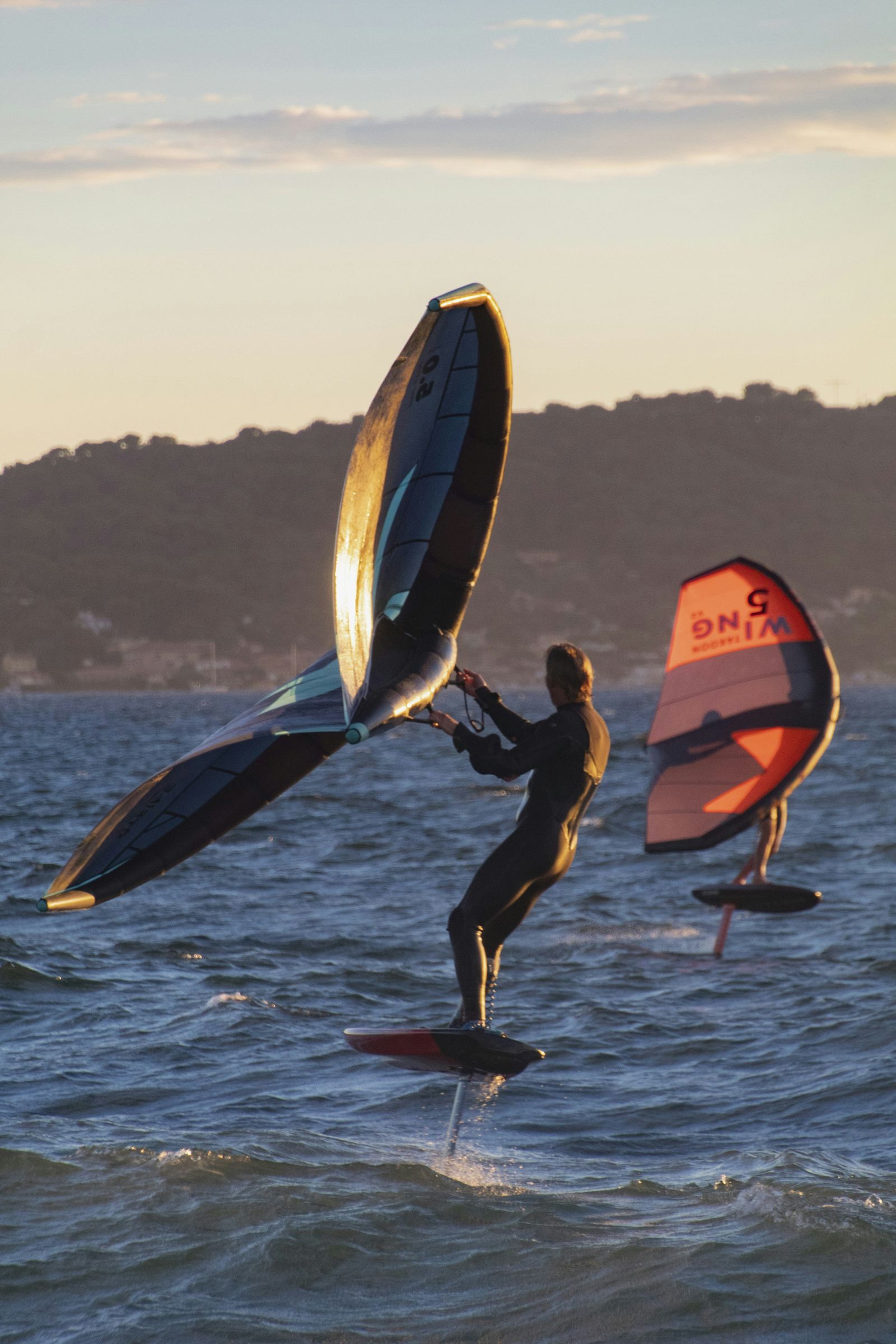
It looks like a magic trick. It isn't — it's two pieces of gear working together, and once you understand what each one does, the whole sport makes a lot more sense.
The two things that make it work
The first piece is the wing itself: an inflatable, hand-held airfoil you grip with both hands, roughly the shape of a stubby kite wing. There's no bar, no flying lines, nothing connecting it to your body or the board. You hold it directly, angle it into the wind for power, and let go or flag it out the instant you don't want that power anymore. That last part matters — it's one of the biggest reasons wing foiling has a reputation as approachable and low-drama compared to gear that's rigged to you.
The second piece is the board underneath you, and this is where the "foiling" part comes in. Instead of a normal board bottom, it has a mast extending down into the water with a hydrofoil — a set of underwater wings — mounted at the bottom. Get enough speed, and that foil generates lift the same way an airplane wing does, physically raising the board (and you) up out of the water. Once you're foiling, only the foil itself is still submerged — the board is riding a few inches to a couple feet above the surface, and the drag that normally slows a board down basically disappears. That's the sensation people chase: it stops feeling like you're moving through water and starts feeling like you're flying just above it.
How it's different from the sports you already half-know
Wing foiling borrows a little from a few sports, which is exactly why it gets compared to all of them — but the differences are real, not cosmetic.
A kite flies on lines, connected to a control bar and usually a harness on your body, staying up in the sky and pulling from a distance. A wing is held directly in your hands at arm's length and powers you right where you're standing — no flying, no re-launching a crashed kite, no bar/line setup to rig and untangle. Launching and landing a wing is dramatically simpler: pick it up, put it down, depower it almost instantly.
A windsurf rig — mast, boom, sail — is mechanically attached to the board, and you stay connected to it while sailing. A wing is completely separate from the board; you hold it in your hands, and the board underneath is just a foil board. That separation is also why wing gear packs down small enough for a car trunk, unlike a full windsurf rig.
Surfing needs breaking waves for speed. Wing foiling doesn't — the wing provides the power, so you can foil on flat water with zero swell, or use small bumps that wouldn't be rideable on a surfboard at all. You can also ride real waves on a wing foil, but you're not dependent on them.
SUP is human-powered and stays on the surface. Wing foiling is wind-powered and lifts off the surface once you're up on the foil — different power source, different feel, though some riders also foil behind a paddle (prone or SUP foiling) with no wing at all. An e-foil uses the same hydrofoil lift, but a battery and motor supply the power instead of wind — no wing, no wind dependency, but also a motor to maintain, a battery to charge, and a throttle doing the work a wing setup asks your arms and legs to do.
Why people fall for it
Part of the appeal is genuinely practical. A wing setup packs down small, doesn't need rigging on the beach the way a windsurf sail does, and works across a wider range of conditions than a lot of people expect — light thermal breezes that wouldn't get a kite up can be plenty to foil in, since the foil needs so little speed to fly. You can ride flat bays, choppy lakes, or ocean swell with the same core gear, and the launch/land process is simple enough to do solo without much drama.
But the real hook is the feeling once you're up on the foil: the drag drops away, the water noise disappears, and you're just gliding — silent, smooth, a couple feet above the surface. Nothing else in wind sports quite replicates it.
Here's the honest part, though: it looks effortless in videos, and it is not effortless the first few sessions. Balancing on a foil board before you're up and planing, timing when to stand, managing the wing with both hands while your legs are doing something new — there's a real learning curve, and most people eat it (literally, into the water) a fair amount early on. The good news is that it's a genuinely learnable curve, not a talent ceiling — with the right gear sized for a beginner and a sensible progression, most people get a real taste of flying within their first few sessions and keep improving from there.
Watch This
How to Wing Foil - Complete Beginner Tutorial
A full visual walkthrough of what a first session actually looks like, if you want to see it before you try it.
Watch on YouTube →Picking where to start
Once you're sold on trying it, where you learn matters almost as much as what gear you learn on. Wing foiling can be picked up efficiently in flat, shallow, forgiving water — and it gets a lot harder to learn in anything else. This isn't a directory of specific beaches (that's what Find a Spot is for) — it's a checklist for evaluating any location you're considering.
Flat water beats waves, every time. Look for protected water — bays, sounds, lakes, inlets — rather than open ocean breaks.
Bottom conditions matter. Shallow, sandy bottoms are ideal, roughly waist-to-chest depth. Avoid rock, coral, or oyster bars that could damage the foil (or you).
Give yourself room to drift. You need enough open space that drifting doesn't put you into a dock, a moored boat, a swimmer, another rider, or the shoreline.
Steady wind beats strong wind. Consistent light-to-moderate wind is far easier to learn in than anything squally or shifting.
Nearby rentals or instruction help a lot, mostly for getting your first setup sized correctly rather than guessing.
Easy beach access matters more than it sounds. You'll be rigging, de-rigging, and possibly self-rescuing more than once — a spot that's a hassle to get in and out of gets old fast.
One more thing worth knowing before you show up: beach orientation relative to wind direction is critical, and it's covered in full on the Safety & Mistakes page. Not every beach faces the same direction, so it's worth knowing two or three spots near you with different orientations — there's almost always one facing the right way for a given day's wind. Find a Spot is built exactly for this: real, specific spots, tagged by who's actually ridden them, so you're not guessing at any of the above from scratch.
These principles are a starting point, not a guarantee — local conditions, seasonality, and the specific beach you choose still matter. But get these basics right and you've already avoided most of what makes a first session frustrating instead of fun.
Once straight-line riding feels comfortable, turning is the next real skill on the horizon — here's a preview of the basics you'll build toward:
If you're already sold and just want to know what to buy, keep moving through the guide — What Gear Do You Actually Need is next.